|
|||||||
|
|
 |
 |
|
||||
|
|
|
 |
 |
 |
 |
||
|
[Author Note: This article has been edited to reflect current information in
the SASS Shooter's Handbook. See the Note at the end of this article if you wish to view or download the current Handbook. I believe I have included all the latest changes, but please check the latest Handbook if you have any questions.]
In cowboy action shooting main matches, all weapons must be originals or reproductions of firearms manufactured prior to 1899
(Colts, Winchesters, Remingtons, Marlins, Henrys, etc.). All revolvers must be single-action (will not fire unless hammer pulled back)
and must be at least .32 centerfire caliber and no larger than .45 caliber. Lead-tipped bullets must be used in competition. Percussion revolvers
must have the same caliber range. All rifles used in competition must shoot the same caliber, lead-tipped bullets outlined for revolvers.
Shotguns must be between 10 to 20 gauge, shooting lead shot. Shotguns with automatic ejectors may be used in competition unless they are
side-by-side models.
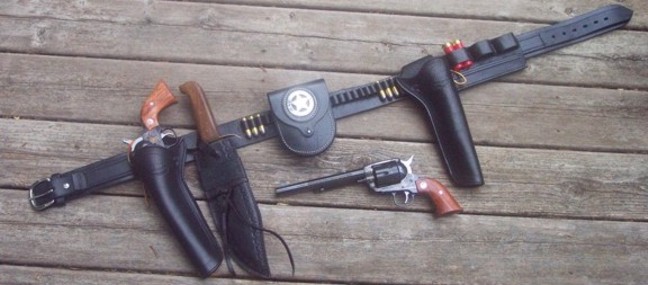
Pictured below is a "rig" (holsters, cartridge belt, Bowie knife, pouch and shot shell slide). The picture shows two .45 long colt caliber,
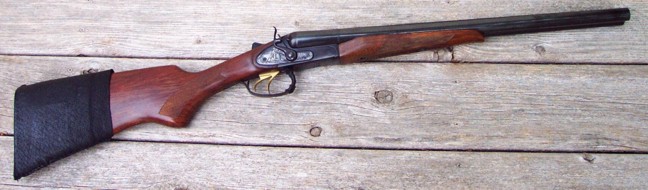
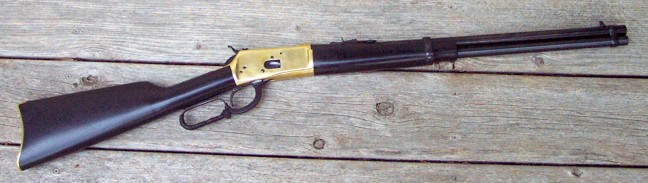
six-shot single action Ruger Vaquero revolvers with 7 1/2 inch barrels. A typical rifle and shotgun used in competition are also pictured below.
Included is a 12 gauge, 20 inch barrel "coach" shotgun made by Baikal and a 20 inch barrel .45 long colt caliber carbine made by Rossi. The
latter is a reproduction of the Winchester 1892 model made famous by John Wayne who used this rifle in many of his movies.
During a match, competitors will shoot in five to six or more "stages" with a group of 8-12 competitiors (the group is referred to as a "posse").
In each stage, competitors will generally shoot at steel targets with 10 pistol rounds (from two revolvers), 10 rifle rounds, and two shot shell
rounds. Your score in each stage is the time when you begin shooting as indicated by a signal from a timing mechanism until finished. Five seconds
are added for each missed target. When the posse finishes its stage as a group, they move to the next stage with similar target and weapon demands
and continue until the posse has shot in all stages. Best time (lowest) across all stages wins the match.
SASS allows competitors to compete in special age, costuming, equipment, and gender shooting categories. Both men and women can compete in
all age categories for which they qualify such as Buckaroos (age 13 and under--and you need to check state laws on this age group), Juniors (age 16 and under), Wranglers (age 36 or older), Forty-Niners
(age 49 or older), Seniors (60 or older), Silver Seniors (age 65 or older), and Elder Statesmen/Grand Dames (age 70 or older). Shooters can also compete
in weapon or shooting style categories such as Duelist or Double Duelist (requires shooting with one hand, no support from the other hand), and the Gunfighter
(shooting one-handed with one gun in each hand). There are additional shooting categories for competitors using blackpowder weapons, such as the
Frontiersman category.
There are two different categories for shooters to choose that are highly dependent on costuming details. The first is the Classic
Cowboy/Cowgirl category which requires the competitor to wear at least five costume details chosen from a list of items ranging from chaps, leggings, western
spurs with spur straps, vest, pocket watch with full chain, wrist cuffs, botas, etc. That category also requires that revolvers be shot duelist or double duelist style. Still another clothing-specific
shooting category is B-Western in which competitors wear clothing used in early western movies (think Roy Rogers, Dale Evans, and Gene Autry.)
The costumes worn in the B-Western category are expected to be fancy and flashy and have specific requirements such as fancy stitching, conchos,
spots, or tooling on belts and holsters. Pants must be worn with a belr, no suspenders. Boots are required and must also be embellished with fancy stitching or multi-color fancy design, cochos, or spots.
Lastly, there are no men-only shooting categories, but women can compete
in female-specifc shooting categories to include all of the above age groups as well as the Duelist, Gunfighter, Classic and B-Western categories.
Rules of competition allow shooters to compete in any category for which they qualify.
The above descriptions of competition categories and requirements are necessarily abbreviated. For a complete description of requirements, see the link to the
SASS Shooter's Handbook below.
Note: The SASS Shooter's Handbook can be found in the SASS website (see SASS website link at the bottom of the Shot Doc home page) and clicking on The Shooting tab, then selecting the Handbooks & Rules option under Cowboy Action Shooting and then click on the SASS Shooter's Handbook selecting the English or other language option.
|
|||||||
|
|
|||||||
 |
|||||||
|
|
|||||||